ADMISSIBILITY & INADMISSIBILITY
Expanded Overview of Admissibility and Inadmissibility in Canada
Canada’s immigration system enforces strict admissibility criteria to ensure that individuals entering the country meet legal, security, and health standards. The Immigration and Refugee Protection Act (IRPA) outlines the conditions under which a person may be admissible or inadmissible, affecting their ability to enter, remain, or obtain status in Canada.
Admissibility: Meeting Canada’s Entry Requirements
To be admissible, individuals must comply with Canadian immigration laws and demonstrate that they do not pose risks to security, public health, or economic stability.
Key Factors for Admissibility
✔ Valid Immigration Status – Applicants must hold appropriate visas, permits, or residency status to enter Canada legally.
✔ Security Clearance – Individuals must pass background checks, ensuring they have no ties to terrorism, espionage, or organized crime.
✔ Medical Fitness – Some applicants must undergo medical examinations to confirm they do not pose public health risks.
✔ Financial Stability – Immigrants must prove they can support themselves financially, preventing reliance on government assistance.
✔ Compliance with Immigration Laws – Applicants must accurately disclose information, avoiding misrepresentation or fraudulent claims.
Admissibility ensures that immigrants contribute positively to Canada’s economy and society while maintaining national security and public welfare.
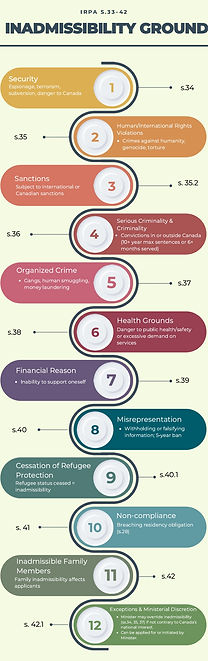
Expanded Grounds for Inadmissibility
Individuals may be deemed inadmissible if they fail to meet Canada’s immigration requirements. Inadmissibility can result in visa refusals, removal orders, or entry bans.
Security Concerns
✔ Espionage & Terrorism – Individuals involved in terrorist activities, espionage, or subversive operations are barred from entry.
✔ Membership in Threat Organizations – Affiliation with groups that pose a risk to Canada’s national security can lead to inadmissibility.
Human Rights Violations
✔ War Crimes & Crimes Against Humanity – Those who have participated in genocide, torture, or persecution are inadmissible.
✔ Violations of International Law – Individuals involved in human trafficking or forced labor may be denied entry.
Criminality & Serious Criminality
✔ Major Offenses – Convictions for drug trafficking, fraud, violent crimes, or impaired driving can result in inadmissibility.
✔ Minor Offenses – Even lesser crimes, such as theft or repeated infractions, may impact admissibility.
Criminal Inadmissibility: How Convictions Affect Immigration Status
Canada enforces strict policies regarding criminal inadmissibility to ensure that individuals entering the country do not pose risks to public safety and legal integrity. Criminal inadmissibility can apply to both foreign nationals and permanent residents, potentially leading to visa refusals, deportation, or entry bans.
Types of Criminal Inadmissibility
✔ Summary Convictions – Less serious offenses, such as theft under a certain amount, disorderly conduct, or minor fraud, may still affect admissibility but can sometimes be overcome through rehabilitation.
✔ Indictable Offenses – Serious crimes, such as violent assaults, major fraud, drug trafficking, and firearm offenses, result in automatic inadmissibility.
✔ Multiple Convictions – Having more than one criminal conviction may impact eligibility, even if the offenses are relatively minor.
✔ Driving-Related Offenses – Impaired driving (DUI/DWI) has become a major ground for inadmissibility in Canada, with strict enforcement against applicants with alcohol or drug-related driving offenses.
Overcoming Criminal Inadmissibility
Individuals with criminal records may have options to reverse inadmissibility if they demonstrate reform and legal compliance.
✔ Criminal Rehabilitation – Available for individuals who have completed sentences at least five years ago and can prove they pose no future risk to public safety.
✔ Record Suspension (Pardon) – Applicants can seek a record suspension to clear their criminal record through Canada's Parole Board, improving admissibility.
✔ Temporary Resident Permit (TRP) – If inadmissibility is temporary, individuals may apply for a TRP, allowing entry for a specific purpose, such as business travel or family matters.
Canada assesses each case individually, ensuring that applicants who demonstrate genuine rehabilitation can overcome inadmissibility.
Health Grounds
✔ Contagious Diseases – Applicants with infectious conditions that pose a public health risk may be denied entry.
✔ Excessive Healthcare Demand – Individuals requiring long-term medical care that burdens Canada’s healthcare system may be inadmissible.
Financial Reasons
✔ Lack of Financial Stability – Applicants unable to demonstrate financial independence may be refused entry.
✔ History of Bankruptcy or Fraud – Individuals with financial misconduct may be deemed inadmissible.
Misrepresentation
✔ False Information & Forged Documents – Providing fraudulent details or withholding critical information can lead to inadmissibility.
✔ Failure to Disclose Past Immigration Violations – Concealing previous deportations or visa refusals may result in entry bans.
Misrepresentation: Consequences of False Information
Providing false or misleading information in immigration applications can result in immediate inadmissibility, preventing entry or leading to legal penalties.
Common Forms of Misrepresentation
✔ Forged or Altered Documents – Submission of fake passports, altered diplomas, or fraudulent employment records can result in bans from applying for up to five years.
✔ Omissions in Immigration History – Applicants who fail to disclose previous visa refusals, deportations, or immigration violations risk inadmissibility.
✔ False Sponsorship Claims – Attempting to sponsor individuals through fraudulent relationships or misrepresenting financial ability may lead to rejection.
✔ False Work or Study Claims – Providing fake proof of employment or education jeopardizes applications.
Misrepresentation not only leads to entry denial but may also result in permanent bans from immigrating to Canada.
Non-Compliance with Immigration Laws
✔ Unauthorized Work – Engaging in employment without proper authorization can lead to removal. ✔ Overstaying a Visa – Remaining in Canada beyond the permitted duration may result in inadmissibility.
✔ Violation of Residency Conditions – Failing to meet permanent residency obligations can lead to status revocation.
Having an Inadmissible Family Member
✔ Impact on Sponsorship – If a close relative is inadmissible, it may affect an applicant’s ability to enter Canada.
Overcoming Inadmissibility
Individuals who are inadmissible may apply for legal remedies to enter Canada under exceptional circumstances.
Temporary Resident Permit (TRP)
✔ Issued for Compelling Reasons – TRPs allow individuals to enter Canada despite inadmissibility, provided they have a valid justification.
✔ Limited Duration – TRPs are temporary and must be renewed or transitioned into permanent residency.
Criminal Rehabilitation
✔ Demonstrating Reform – Individuals with past convictions may apply for rehabilitation, proving they no longer pose a risk.
✔ Eligibility Based on Timeframe – Rehabilitation is available if at least five years have passed since the completion of a sentence.
Record Suspension (Pardon)
✔ Clearing Criminal History – A record suspension removes past convictions from an individual’s record, improving admissibility.
✔ Application Through Parole Board – Individuals must apply for a pardon through Canada’s Parole Board, demonstrating good conduct.
Canada enforces strict inadmissibility policies to protect national security, public health, and economic stability, while providing legal pathways for individuals to overcome barriers.